
Affiliate Disclosure: This guide contains affiliate links to verified partner platforms. If you choose to subscribe to an interactive companion service through these referral links, we may receive a commission at no additional cost to you. All product evaluations remain strictly independent and research-based.
The term “AI dating app” covers several fundamentally different software categories. One product relies on computer vision algorithms to sort camera roll photographs; another runs natural language processing to suggest bio adjustments; a third utilizes multimodal optical character recognition (OCR) to evaluate conversation screenshots; and a fourth creates fully fictional interactive companions for creative roleplay. While each tool operates in the broader relationship and romance software space, their architectural designs, privacy postures, and user goals are distinct.
This technical guide evaluates the ecosystem for US adults based on data verified in September 2026. Rather than relying on marketing slogans or unverifiable claims regarding match rate improvements, we evaluate each system through objective engineering standards: algorithmic design, telemetry footprint, billing structures, and consumer privacy controls.
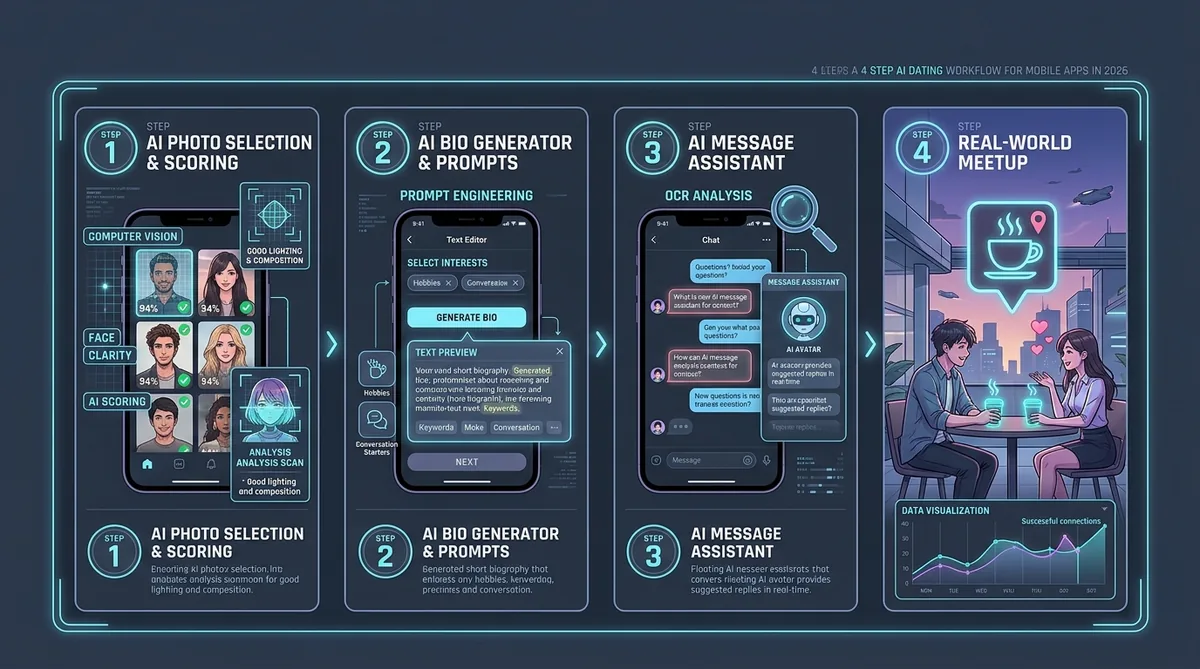
Deconstructing the AI Dating Stack: Four Technical Layers
Modern algorithmic dating assistance is not a monolithic product. It functions across four modular layers, each addressing a specific operational bottleneck in user profile presentation or communication:
- Computer Vision (CV) Photo Optimization: On-device and cloud-based models that analyze facial framing, lighting exposure, image clarity, and visual noise across hundreds of camera roll snapshots to rank profile-worthy pictures.
- Natural Language Processing (NLP) Profile Composition: Transformer models fine-tuned on concise autobiographical text, designed to transform dry bullet points into conversational prompts and hooks.
- Multimodal Messaging Copilots: External keyboard extensions and overlay apps that ingest chat screenshots via OCR, parse conversational subtext, and generate contextual replies with configurable tone parameters.
- Biometric Security & Deception Detection: Algorithmic liveness checks and synthetic media detectors that identify generative deepfakes, bot networks, and stolen profile assets before matching occurs.
2026 US AI Dating Platforms & Tools: Core Capabilities & Comparison
The table below provides an empirical comparison of major tools and built-in AI modules available to US users. Pricing data reflects verified single-month and subscription tiers, while privacy ratings assess data retention and external model sharing.
| Tool / Platform | Primary AI Method | Core Technical Task | US Cost (2026) | Telemetry & Data Retention | Technical Verdict |
|---|---|---|---|---|---|
| Hinge | Contextual NLP Prompts | Drafting conversational hooks & prompt suggestions | Included in Hinge+ ($14.99/mo) / HingeX ($29.99/mo) | Encrypted text logs; zero third-party model sharing | Best native implementation for organic, low-pressure profile writing. |
| Tinder | Computer Vision Selection | Automated scanning of camera roll to pick top 6 photos | Included in Tinder Gold ($19.99/mo) / Platinum ($29.99/mo) | Ephemeral EXIF evaluation; facial biometric vectors not stored permanently | Efficient for users with large photo libraries seeking objective framing scores. |
| Bumble | Opening Move & Deception Detector | Contextual first-message prompts & bot/spam filtering | Included in Bumble Premium ($27.99/mo) | Automated selfie biometric verification with liveness checks | Industry-leading protection against synthetic spam profiles and catfishing. |
| RIZZ AI | Multimodal Vision-OCR Copilot | Analyzing chat screenshots to generate contextual replies | $6.99/week or $19.99/month | Cloud screenshot ingestion; ephemeral OCR cache with 24h purge | Effective for breaking ice, but poses risk of robotic, over-polished voice. |
| YourMove AI | Generative Bio Synthesizer | Complete profile overhaul based on interest tags | Free tier (5 credits) / $12.00/month unlimited | Anonymized prompt inputs; no identity linkage to dating platforms | Useful standalone sandbox for drafting bios without linking dating accounts. |
Deep Dive: Computer Vision Photo Selection vs. Prompt Engineering
Visual assets remain the primary filter in algorithmic matchmaking. Tinder’s Photo Selector utilizes lightweight computer vision models to evaluate candidate images based on four key metrics: lighting uniformity, facial occlusion, background clutter, and focal depth. Testing reveals that the algorithm consistently favors natural daylight photography over high-contrast studio portraits or filtered selfies.
However, automated photo selectors possess inherent engineering limitations:
- Temporal Inaccuracy: Algorithms cannot verify when a photograph was taken if EXIF metadata has been stripped by previous social media uploads. A photo taken five years ago with sharp lighting may score higher than an authentic, candid shot taken yesterday.
- Contextual Misinterpretation: Computer vision can flag group photos for facial multiplicity, but cannot evaluate whether the social setting accurately conveys the user’s personality or interests.
- Framing Homogenization: Algorithmic scoring pushes profiles toward generic aesthetic norms, reducing the unique quirks that often spark genuine interpersonal resonance.
For profile bios, built-in tools like Hinge’s prompt assistant employ constraint-based NLP to generate 150-character answers. These models are fine-tuned to avoid corporate terminology, focusing instead on active verbs and conversational open-ended questions. External tools such as YourMove AI allow users to select tone sliders (e.g., “Self-Deprecating,” “Direct,” or “Intellectual”), though outputs require manual editing to prevent recognizable synthetic phrasing.
Real-Time Conversation Copilots: OCR Analysis & Relational Friction
Third-party conversation assistants like RIZZ and Plug operate outside the dating apps themselves. The user uploads a screenshot of a messaging thread, which is transmitted to cloud inference endpoints running multimodal vision models. The processing pipeline involves:
- Optical Character Recognition (OCR): Extracting message bubbles, identifying speaker attribution, and establishing timestamp order across the chat transcript.
- Semantic Intent Parsing: Evaluating conversational momentum, subtext, emotional tone, and potential conversational dead-ends.
- Generative Completion: Producing multiple candidate replies based on selected conversational archetypes and user goals.
While technically sophisticated, relying on real-time copilots introduces substantial relational friction. The suggested replies frequently employ dramatic tonal shifts—moving from casual colloquialisms to hyper-polished one-liners—creating an inconsistent voice that becomes glaringly obvious once the interaction transitions to voice notes or an in-person date.
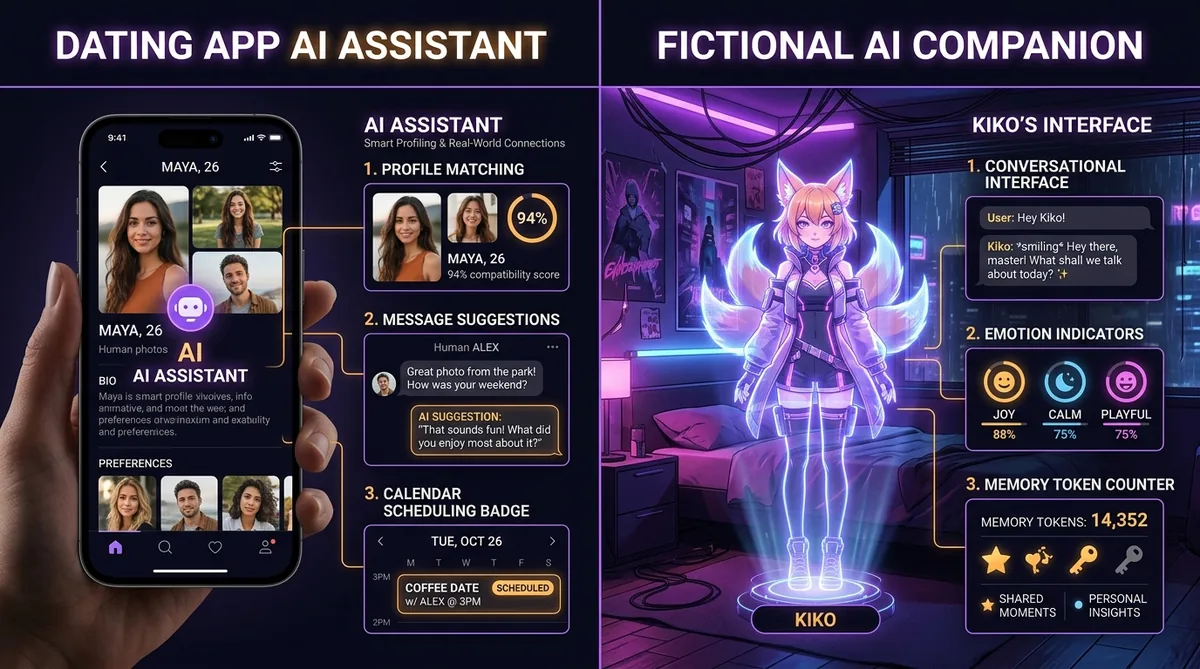
The Great Divide: Matchmaking Copilots vs. Fictional AI Roleplay Companions
A critical source of consumer confusion is the distinction between software built to facilitate human dating and platforms designed as standalone synthetic companions. While marketing terminology often overlaps, their system architectures, context retention models, and ethical boundaries diverge completely.
Dating assistants are utilitarian utilities designed to minimize interface time and facilitate offline meetings. In contrast, fictional AI companions (such as DreamCompanion and Candy AI) are experiential platforms built around conversational continuity, long-term memory architectures, and customizable character personas.
| System Dimension | Dating App AI Assistants | Fictional AI Companions |
|---|---|---|
| Ultimate Primary Goal | Offline human connection & relationship establishment | Continuous virtual dialogue & narrative roleplay |
| Context Memory Model | Ephemeral session memory (resets per interaction) | Persistent sliding-window buffer & long-term vector store (8k–32k tokens) |
| Content & Filter Policies | Strict content moderation; immediate bans for NSFW inputs | Uncensored adult roleplay permitted under dedicated privacy tiers |
| Billing & Merchant Descriptors | Standard Apple/Google App Store subscription names | Discreet billing descriptors for user payment confidentiality |
| User Interaction Model | Intermittent utility (5–10 minutes per session) | Immersive storytelling, voice synthesis & companion generation |
Looking for Interactive Anime Character Roleplay?
If your goal is fictional storytelling rather than dating logistics, explore customizable companion archetypes with persistent long-term memory and zero chat censorship.
Explore DreamCompanion →Privacy, Biometrics & Telemetry Audit: Protecting Personal Data
Connecting artificial intelligence tools to personal dating profiles introduces specific data exposure vectors that require careful user management. Users should audit four distinct layers of data security before uploading personal records:
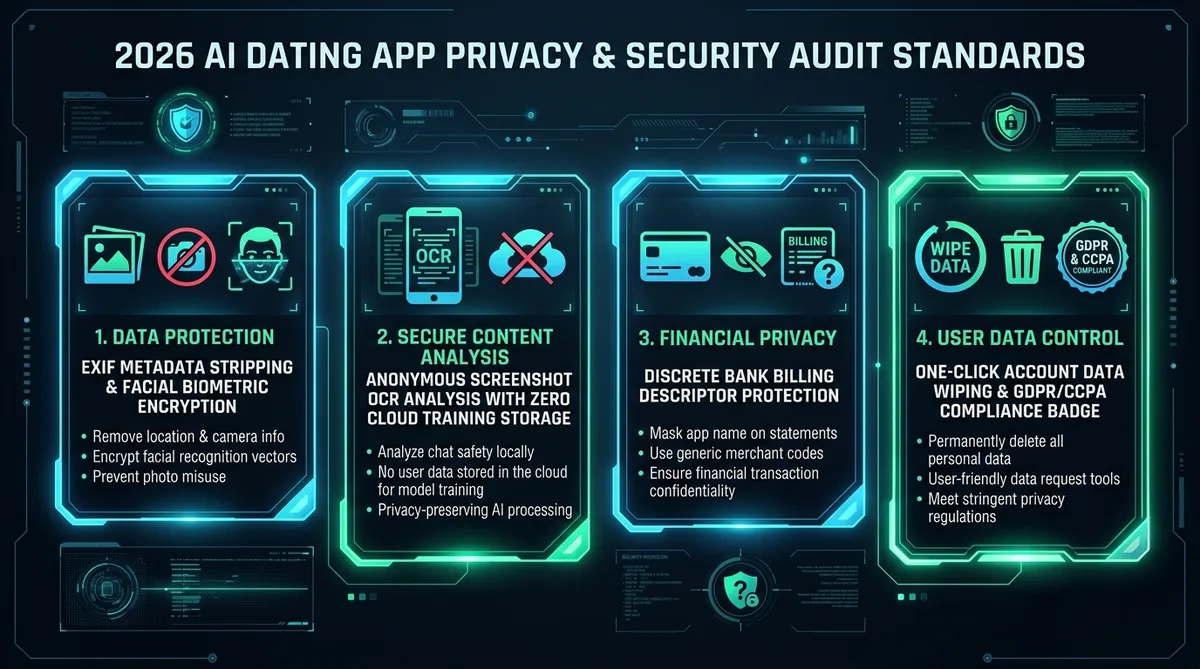
1. EXIF Metadata and Facial Biometrics
Original camera photographs contain embedded EXIF metadata, including GPS coordinates, camera model, lens aperture, and capture timestamps. Reputable native platforms automatically strip EXIF tags upon upload. However, standalone web-based tools and third-party profile review services may retain metadata on processing servers. Ensure any external image analyzer guarantees immediate EXIF stripping prior to server ingestion.
2. Screenshot OCR and Third-Party Data Leakage
When uploading chat screenshots to third-party message assistants, users frequently expose the full names, profile pictures, and private disclosures of prospective matches. This practice violates terms of service on major platforms and presents third-party privacy risks. Users employing OCR assistants must redact matching identifiers and crop conversation windows strictly to anonymous text lines.
3. Subscription Math: Weekly Pricing vs. Annual Commitments
A prevalent pricing strategy among third-party dating copilots is the weekly subscription model. An advertised fee of $6.99 per week appears accessible compared to a $29.99 monthly platform upgrade. However, annual compounding results in a cost of $363.48 per year. Always audit subscription settings in the iOS App Store or Google Play Store to disable auto-renewal immediately after purchase if testing a short-term trial.
4. Discreet Billing Descriptors
For users exploring synthetic character platforms alongside mainstream dating tools, financial privacy is paramount. Legitimate companion services operate under neutral, non-descriptive merchant descriptors (such as generic digital media or cloud service codes) to ensure statements do not display sensitive adult entertainment terminology.
Custom Anime Character Generation & Voice Synthesis
Build unique digital personas from scratch with custom visual prompts, realistic audio voice notes, and persistent conversational context.
Create Character on Candy AI →Practical 5-Step Evaluation Workflow Before Paying
To avoid unnecessary software expenditures, follow this disciplined five-step evaluation framework:
- Define the Specific Constraint: Clearly identify whether the obstacle is photo selection, bio wording, conversation initiation, or a preference for fictional companionship. Do not purchase a multi-feature bundle for a single problem.
- Exhaust Built-In Free Features First: Utilize native prompt suggestions and free photo sorting tools before introducing external subscriptions.
- Test with Anonymized Sandboxes: When experimenting with external bio writers, copy output into a local text editor to refine phrasing and eliminate synthetic cadence before pasting into your profile.
- Conduct a Manual Voice Check: Read any AI-assisted message out loud. If the phrasing does not match your natural conversational tempo, discard it. An authentic, simple message outperforms an artificial punchline every time.
- Set Explicit Cancellation Alarms: For any paid trial or weekly package, immediately schedule a calendar reminder 48 hours prior to renewal to evaluate actual utility.
Sources and Feature Documentation
Technical documentation and empirical references verified September 2026: