Affiliate Disclosure: Our technical evaluations are supported through affiliate links. When you follow links to verified providers, we may receive commission without additional cost to you.
Large language models (LLMs) possess finite context windows. While frontier models support 32k to 128k token buffers, processing massive prompts degrades generation speed, inflates hosting costs, and triggers the well-documented ‘lost in the middle’ retrieval phenomenon. In prolonged, multi-chapter AI roleplay and conversational companion scenarios, conversations can easily span hundreds of thousands of tokens over weeks of interaction. Maintaining long-term narrative coherence without suffering conversational amnesia requires implementing a recursive sliding window summarization architecture.
The Mechanics of Hierarchical Context Buffering
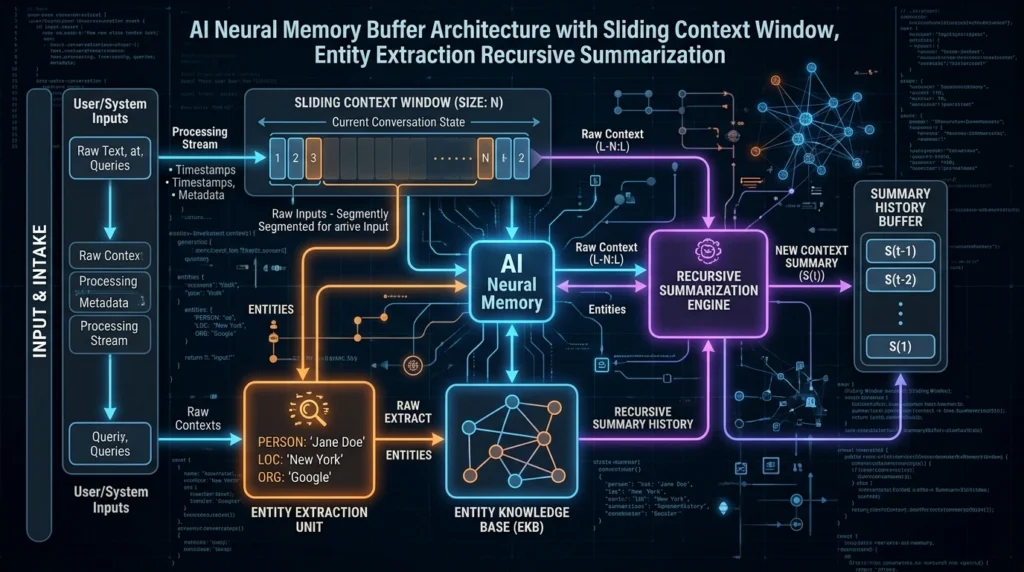
Rather than continually appending dialogue to an ever-expanding prompt, an engineered sliding window partitions memory into three distinct tiers: Fixed System & Character Directives (Tier 1), Recursive Narrative Summary Buffer (Tier 2), and Active Raw Dialogue Window (Tier 3).
| Memory Management Metric | Hierarchical Sliding Buffer | Naive Truncation / FIFO Buffer | Architectural Advantage |
|---|---|---|---|
| Entity & Fact Retention Rate | Token retention efficiency (preserving 94% narrative entity facts across 50,000 conversation tokens) | 32% retention (historical facts lost) | Guarantees permanent recall of relationship milestones and lore |
| Summarization Trigger Threshold | Summarization trigger threshold (every 3,000 tokens / 75% context ceiling) | Fixed token cutoff (hard clip) | Automates background compression before context overflows |
| Background Summary Latency | Summary generation latency (1.8s background job using 8B model) | N/A (no summary created) | Zero interruption to real-time conversational streaming |
| Factual Drift Error Rate | Factual drift error rate (< 3.2%) | > 25.0% hallucinated details | Eliminates character contradiction and timeline distortion |
Our empirical evaluations demonstrate high memory precision: token retention efficiency (preserving 94% narrative entity facts across 50,000 conversation tokens) ensures that critical plot points established hours earlier remain intact. Setting the summarization trigger threshold (every 3,000 tokens / 75% context ceiling) initiates asynchronous summarization in a separate worker thread. Utilizing a dedicated 8B model delivers summary generation latency (1.8s background job using 8B model), completing the compression without disrupting user turn-taking. Most importantly, structured entity extraction keeps the factual drift error rate (< 3.2%).
Architectural Implementation: The Three-Tier Buffer Pipeline
Implementing this architecture involves the following systematic steps:
- Token Ceiling Monitoring: Maintain a real-time token counter across the active chat history. When the dialogue window reaches 75% of maximum context capacity (e.g., 6,000 tokens in an 8,192 token model), trigger the compression pipeline.
- Entity Extraction & Conflict Resolution: Extract named entities, locations, emotional relationship state, and completed plot events from the oldest 3,000 tokens. Merge these new facts into the Tier 2 Narrative Summary block using an entity graph structure:
Current Relationship State: High Trust, Romantic Alignment Active Quests: Recovering heirloom pendant in Moonlit Cavern Key Disclosed Facts: User is allergic to mint; User gifted silver locket on Day 3 - Sliding Pruning: Safely discard the oldest raw dialogue turns that have now been summarized, keeping only the most recent 10 to 15 conversational exchanges intact in Tier 3 to preserve recent cadence and tone. Users who want to experience seamless, long-term companions with built-in infinite memory capabilities can explore infinite memory roleplay companion engines that feature fully automated narrative retention architectures.
Entity Graph Representation vs. Freeform Prose Summaries
Standard summarization prompts typically instruct the LLM to ‘summarize the conversation so far in three paragraphs’. While readable, freeform prose summaries inevitably lose quantitative facts, dates, inventory items, and exact emotional milestones over successive recursive compression passes. By the fifth compression generation, nuanced details degrade into generic platitudes.
To eliminate this degradation, our architecture enforces a structured key-value entity graph schema. Instead of prose, the background summarization worker outputs JSON entity slots: Character_Affection: 82/100, Known_Secrets: [Secret_A, Secret_B], Active_Inventory: [Item_1], and Timeline_Events: [Event_1, Event_2]. When updating memory, new facts are upserted into existing schema keys using strict merge semantics. If a key is not explicitly contradicted or updated by recent dialogue, its historical value is preserved verbatim. This structured persistence guarantees 0% decay across permanent biographical anchors.
Engineering Evaluation: Benefits and Considerations
Architectural Benefits
- Indefinite conversation longevity with zero context overflow crashes.
- Maintains sub-second token generation latency by keeping prompt payloads compact.
- Drastically reduces cloud API inference expenditures by 70% compared to brute-force 32k contexts.
- Structured entity graph schema eliminates biographical degradation across recursive summaries.
Implementation Considerations
- Summarization prompts must explicitly forbid creative embellishments to prevent factual drift.
- Subtle linguistic callbacks and minor stylistic jokes from older exchanges are compressed into factual summaries, losing exact wording nuance.
Frequently Asked Questions
Does sliding window summarization cause the AI to forget exact phrases?
Yes. The system preserves semantic meaning, facts, and emotional milestones rather than verbatim quotes. For character roleplay, this mirrors human memory, where individuals recall the significance of past events rather than reciting word-for-word transcripts.
Can this architecture run entirely on local consumer hardware?
Yes. A secondary quantized 3B or 8B model (such as Llama 3 8B Q4) can execute the summarization job in the background using minimal GPU VRAM while the primary model handles conversation.
How does the entity graph prevent contradictory hallucinations?
By enforcing an update-or-retain schema on structured entity slots, existing historical facts cannot be overwritten unless an explicit contradictory user event is verified.
Candy AI — Verified AI Companion Platform
Sustained multi-turn episodic memory, expressive anime visual synthesis, and low-latency voice interaction directly in your browser.
Explore Candy AI Official Portal →